Wednesday, April 12, 2017

Sport

Football

VfB Stuttgart's home ground, the Mercedes-Benz Arena in Bad Cannstatt. In the background: the Stuttgart Spring Festival
As in the rest of Germany, football is the most popular sport in Stuttgart which is home to 'The Reds' and 'The Blues'. 'The Reds', VfB Stuttgart, are the most famous and popular local club. An established team currently playing in the German 2. Bundesliga, VfB was founded in 1893 and has won five German titles since 1950, most recently in 1992 and 2007. VfB is based at the Mercedes-Benz Arena in Bad Cannstatt.
'The Blues', Stuttgarter Kickers, are the second most important football team. They currently play in the Regionalliga Südwest (fourth division) at the smaller Gazi Stadium close to the TV tower in Degerloch.
Other lower-division football teams are Sportfreunde Stuttgart – most famous for taking part in the Sir Thomas Lipton Trophy in 1908, considered the first World Cup[181] – and FV Zuffenhausen.

Other sports

Stuttgart is home to VfL Pfullingen/Stuttgart, a local handball team that played in the national league from 2001 to 2006 in the Schleyerhalle. Its three-times German champion women's volleyball team, CJD Feuerbach, has now stopped playing for financial reasons but there is now Stuttgart Volleyball Club with a women's team in the 2nd southern league.
Stuttgart has two major ice hockey teams. Stuttgart Rebels EC, plays in the "Landesliga" (4th tier) at the Waldau ice rink in Degerloch. The Bietigheim Bissingen Steelers play in the 2nd division of the DEL (DEL2). The Steelers play in the new Ege Trans Arena in Bietigheim.
The strongest local water polo team is SV Cannstatt, which won the German championship in 2006.
Stuttgart has two American Football teams: the Stuttgart Nighthawks American football team, who play in the Western Europe Pro League, and the Stuttgart Scorpions, who play in Stuttgarter Kickers' Gazi Stadium.
Australian Football is practiced by the Stuttgart Emus – one of only six active teams in Germany. It participates in the Australian Football League Germany when they play their home games in the Eberhard-Bauer-Stadion
TC Weissenhof is a Stuttgart-based women's tennis team that has won the German championship four times. Another women's team is TEC Waldau Stuttgart (German champions in 2006).
HTC Stuttgarter Kickers is one of the most successful field hockey clubs in Germany, having won the German championship in 2005 and a European title in 2006.

Sporting events

Stuttgart has a reputation for staging major events, including the FIFA World Cup 1974, the finals stages of the FIBA EuroBasket 1985, the UEFA Euro 1988, and the World Championships in Athletics 1993. It was also one of the twelve host cities of the FIFA World Cup 2006. Six matches, three of them second round matches, including the 3rd and 4th place playoff, were played at the Gottlieb Daimler Stadium (today Mercedes-Benz Arena). Stuttgart was also 2007 European Capital of Sport,[182] hosting events such as the UCI World Cycling Championships Road Race and the IAAF World Athletics Final.
Other famous sports venues are the Weissenhof tennis courts, where the annual Mercedes Cup tennis tournament is played, the Porsche Arena (hosting tennis, basketball and handball) and the Schleyerhalle (boxing, equestrianism/show jumping, gymnastics, track cycling etc.), Scharrena Stuttgart.

International relations

Twin towns and sister cities

Stuttgart is twinned with the following cities:[183]

Friendships

Stuttgart also has special friendships with the following cities:[189]
The city district of Bad Cannstatt, which has the second largest mineral water sources in Europe, has a partnership with:
  • Hungary Újbuda, the 11th district of Budapest, Hungary,[192] which has the largest mineral water sources in Europe.

Notable residents

In Popular Culture

Gaming

Novels

  • In the 2005 novel The Book Thief, protagonist Max Vandenburg resides in Stuttgart until his flight later in the book.[199]

TV and Cinema

  • In the 2012 film The Avengers, the villain Loki is tracked to a gala in Stuttgart, where he intends to steal a large quantity of iridium for his schemes. These scenes were actually filmed in Cleveland, Ohio, and a number of Stuttgart residents noted the errors in the film's depiction of the city.[200]

Gallery

Stuttgart at night, looking northwest

Rail links

Stuttgart is a hub in the InterCityExpress and InterCity networks of Deutsche Bahn AG (DBAG), with through services to most other major German cities. It also operates international services to Strasbourg, Vienna, Zürich and Paris (five times a day, journey time 3 hours 11 minutes).[179]
Long distance trains stop at Stuttgart Hauptbahnhof, the city's main line terminus which is also used by regional DBAG RegionalExpress and RegionalBahn for services to stations in the Stuttgart metropolitan area. The local rail networks (see above) operate underneath the terminus.[citation needed]
Stuttgart also has its own rail freight centre with marshalling yards and a container terminal in the Obertürkheim area of Hedelfingen.[citation needed]

Rail: The Stuttgart 21 project

After years of political debate and controversy, plans were approved in October 2007 to convert the existing above-ground main train station to an underground through station. The Stuttgart 21 project will include the rebuilding of surface and underground lines connecting the station in Stuttgart's enclosed central valley with existing railway and underground lines. Building work started in 2010 with controversial modifications to the Hauptbahnhof and should be completed in 2020.

Air transport

Stuttgart is served by Stuttgart Airport (German: Flughafen Stuttgart, IATA airport code STR), an international airport approximately 13 km (8 mi) south of the city centre on land belonging mainly to neighboring towns. It takes 30 minutes to reach the airport from the city center using S-Bahn lines S2 or S3. Stuttgart airport is Germany's only international airport with one runway. Despite protests and local initiatives, surveys are currently underway to assess the impact of a second runway.[180]

Road transport

Stuttgart is served by Autobahn A8, that runs east-west from Karlsruhe to Munich, and Autobahn A81 that runs north-south from Würzburg to Singen. The Autobahn A831 is a short spur entering the southern side of Stuttgart.
Port on Neckar River in Stuttgart
Besides these Autobahns, Stuttgart is served by a large number of expressways, many of which are built to Autobahn standards, and were once intended to carry an A-number. Important expressways like B10, B14, B27 and B29 connect Stuttgart with its suburbs. Due to the hilly surroundings, there are many road tunnels in and around Stuttgart. There are also a number of road tunnels under intersections in the center of Stuttgart.

Waterways

Stuttgart has an inland port in Hedelfingen on the Neckar.

Media and publishing

One of the headquarters of the public Südwestrundfunk (SWR; Southwest Broadcasting) channels (several radio and one TV channel; regional focus on the southwestern German States of Baden-Württemberg and Rhineland-Palatinate) is located in Stuttgart (the other ones being Baden-Baden and Mainz). It also has a Landesmedienzentrum, a State media center.
Furthermore, the city is a significant centre of publishing and specialist printing, with renowned houses such as Georg von Holtzbrinck Publishing Group, Ernst Klett Verlag (schoolbooks), Kohlhammer Verlag, Metzler Verlag and Motor Presse having their head offices there. The Reclam Verlag is located in nearby Ditzingen.
The newspapers Stuttgarter Zeitung (StZ; regional, with significant supra-regional, national and international sections) and Stuttgarter Nachrichten (StN; regional) are published here as well as a number of smaller, local papers such as Cannstatter Zeitung.
As is the case wherever the US military is stationed, there is an American Forces Network (AFN) station. It transmits on FM on 102.3 MHz from Fernmeldeturm Frauenkopf and on AM on 1143 kHz from Hirschlanden transmitter.

Transport

Following the suit of other German cities such as Berlin, Cologne and Hanover, on 1 March 2008 a Low Emission Zone (LEZ) came into effect in Stuttgart with the aim of improving air quality. This affects all vehicles entering the Stuttgart 'Environmental zone' (Umweltzone), including vehicles from abroad.[177][178]

Local transport

Stuttgart Stadtbahn
Stuttgart S-Bahn
Stuttgart Hauptbahnhof (main railway station)
Stuttgart has a light rail system known as the Stuttgart Stadtbahn. In the city center and densely built-up areas, the Stadtbahn runs underground. Stations are signposted with a 'U' symbol, which stands for Untergrundbahn (underground rail). Until 2007, Stuttgart also operated regular trams. Stuttgart also has a large bus network. Stadtbahn lines and buses are operated by the Stuttgarter Straßenbahnen AG (SSB). The outlying suburbs of Stuttgart and nearby towns are served by a suburban railway system called the Stuttgart S-Bahn, using tracks supplied by the national Deutsche Bahn AG (DBAG).
A peculiarity of Stuttgart is the Zahnradbahn, a rack railway that is powered by electricity and operates between Marienplatz in the southern inner-city district of the city and the district of Degerloch. It is the only urban rack railway in Germany. Stuttgart also has a Standseilbahn, a funicular railway that operates in the Heslach area and the forest cemetery (Waldfriedhof). In Killesberg Park, on a prominent hill overlooking the city, there is the miniature railway run by diesel (and on weekends with steam).

Education and research

Stuttgart and its region have been home to some significant figures of German thought and literature, the most important ones being Georg Wilhelm Friedrich Hegel, Friedrich Schiller and Friedrich Hölderlin.
The city, in its engineering tradition as the cradle of the automobile, has also always been a fruitful place of research and innovation. Stuttgart has Germany's second-highest number of institutions (six) of applied research of the Fraunhofer Society (after Dresden).

Tertiary education

The city is not considered a traditional university city, but nevertheless has a variety of institutions of higher education. The most significant of them are:
  • University of Stuttgart, it is the fourth biggest university in Baden-Württemberg after Heidelberg, Tübingen and Freiburg. Founded in 1829, it was a Technische Hochschule ("Technical University") until 1967, when it was renamed to "university". Its campus for social sciences and architecture is located in the city centre, near the main train station, while the natural science campus is in the southwestern city district of Vaihingen. Historically, it has been especially renowned for its faculty of architecture (Stuttgarter Schule). Today, its main focus is on engineering and other technical subjects.
  • University of Hohenheim, founded in 1818 as an academy for agricultural science and forestry. While these subjects are still taught there today, its other focus today is on business administration. It is located in Hohenheim quarter of the southern city district of Plieningen.
  • State University of Music and Performing Arts Stuttgart, founded in 1857, located in the city center, next to the Neue Staatsgalerie.
  • State Academy of Fine Arts in Stuttgart, one of the biggest art colleges in Germany, founded in 1761, located in the Killesberg quarter of the northern city district Stuttgart-Nord.
  • Stuttgart Media University (Hochschule der Medien Stuttgart), founded in 2001 as a university of applied sciences, a merger of the former College of Printing and Publishing and the College of Librarianship, located in Vaihingen.
  • Stuttgart Technology University of Applied Sciences (Hochschule für Technik Stuttgart), founded in 1832 as a college for craftsmanship, university of applied sciences since 1971, located in the city center, near the University of Stuttgart's city-center campus.
  • University of Cooperative Education Baden-Württemberg, founded in 1974, with a focus on practical experience, subjects are business, technology and social work.
Historically, an elite military academy existed in Stuttgart in the late 18th century (1770–1794), the Hohe Karlsschule, at Solitude Castle. Friedrich Schiller and the city's most famous Classicist architect, Nikolaus Friedrich von Thouret, were among its many esteemed alumni.

Primary and secondary education

The first Waldorf School (also known as Rudolf Steiner School) was founded here in 1919 by the director of the Waldorf Astoria tobacco factory, Emil Molt, and Austrian social thinker Rudolf Steiner, a comprehensive school following Steiner's educational principles of anthroposophy and humanistic ideals. Today, four of these schools are located in Stuttgart.

International School

Since 1985 Stuttgart is home to the International School of Stuttgart,[174] one of less than 100 schools worldwide that offer all three International Baccalaureate programs- the IB Primary Years (Early Learning to Grade 5), IB Middle Years (Grade 6 to 10), IB Diploma (grades 11–12).[175] The International School of Stuttgart is accredited by both the Council of International Schools and the New England Association of Schools and Colleges.[176]

Economy

The Stuttgart area is known for its high-tech industry. Some of its most prominent companies include Daimler AG, Porsche, Bosch, Celesio, Hewlett-Packard, IBM, Sika – all of whom have their world or European headquarters here.
Stuttgart is home to Germany's ninth biggest exhibition center, Stuttgart Trade Fair which lies on the city outskirts next to Stuttgart Airport. Hundreds of SMEs are still based in Stuttgart (often termed Mittelstand), many still in family ownership with strong ties to the automotive, electronics, engineering and high-tech industry.
Stuttgart has the highest general standard of prosperity of any city in Germany.[171] Its nominal GDP per capita is €57,100 and GDP purchasing power parity (PPP) per capita is €55,400. Total GDP of Stuttgart is €33.9 billion, of which service sector contributes around 65.3%, industry 34.5%, and agriculture 0.2%.[citation needed]

The cradle of the automobile

The automobile and motorcycle were purported to have been invented in Stuttgart (by Karl Benz and subsequently industrialized in 1887 by Gottlieb Daimler and Wilhelm Maybach at the Daimler Motoren Gesellschaft). As a result, it is considered to be the starting point of the worldwide automotive industry and is sometimes referred to as the 'cradle of the automobile'.[19] Today, Mercedes-Benz and Porsche both have their headquarters in Stuttgart, as well as automotive parts giants Bosch and Mahle. A number of auto-enthusiast magazines are published in Stuttgart.[172]

Science and research and development

The region currently has Germany's highest density of scientific, academic and research organisations. No other region in Germany registers so many patents and designs as Stuttgart.[173] Almost 45% of Baden-Württemberg scientists involved in R&D are based directly in the Swabian capital. More than 11% of all German R&D costs are invested in the Stuttgart Region (approximately 4.3 billion euros per year). In addition to several universities and colleges (e.g. University of Stuttgart, University of Hohenheim, Stuttgart Institute of Management and Technology[28] and several Stuttgart Universities of Applied Sciences), the area is home to six Fraunhofer institutes, four institutes of collaborative industrial research at local universities, two Max-Planck institutes and a major establishment of the German Aerospace Centre (DLR).
The 'Königsbau' on Schlossplatz, former home to the Stuttgart Stock Exchange

Financial services

The Stuttgart Stock Exchange is the second largest in Germany (after Frankfurt). Many leading companies in the financial services sector are headquartered in Stuttgart with around 100 credit institutes in total (e.g. LBBW Bank, Wüstenrot & Württembergische, Allianz Life Assurance).
Kriegsberg vineyard in the city center

A history of wine and beer

Stuttgart is the only city in Germany where wine grapes are grown within the urban area, mainly in the districts of Rotenberg, Uhlbach and Untertürkheim.
Wine-growing in the area dates back to 1108 when, according to State archives, Blaubeuren Abbey was given vineyards in Stuttgart as a gift from 'Monk Ulrich'. In the 17th century the city was the third largest German wine-growing community in the Holy Roman Empire. Wine remained Stuttgart's leading source of income well into the 19th century.
Stuttgart is still one of Germany's largest wine-growing cities with more than 400 hectares of vine area, thanks in main to its location at the center of Germany's fourth largest wine region, the Württemberg wine growing area which covers 11,522 hectares (28,470 acres) and is one of only 13 official areas captured under German Wine law. The continuing importance of wine to the local economy is marked every year at the annual wine festival ('Weindorf').
Stuttgart also has several famous breweries such as Stuttgarter Hofbräu, Dinkelacker, and Schwaben Bräu.

Politics

Stuttgart's current Bürgermeister (mayor) is Fritz Kuhn of the centre-left Alliance '90/The Greens party (German Green party).

City government past and present

When Stuttgart was run as a (or within) the Duchy of Württemberg, it was governed by a type of protectorate called a Vogt appointed by the Duke. After 1811 this role was fulfilled by a City Director or 'Stadtdirektor'. After 1819 the community elected its own community mayor or 'Schultheiß'. Since 1930 the title of Oberbürgermeister (the nearest equivalent of which would be an executive form of Lord Mayor in English) has applied to Stuttgart and all other Württemberg towns of more than 20,000 inhabitants.
At the end of the Second World War, French administrators appointed the independent politician Arnulf Klett as Burgomaster, a role he fulfilled without interruption until his death in 1974. Since this time Stuttgart has mainly been governed by the CDU. One former mayor was Manfred Rommel (son of perhaps the most famous German field marshal of World War II, Erwin Rommel).
As the capital of Baden-Württemberg, Stuttgart is an important political centre in Germany and the seat of the State Parliament, or Landtag as well as all Baden-Württemberg state departments.
In June 2009, for the first time the Greens gained the most seats in a German city with more than 500,000 inhabitants, effectively changing the balance of power in the city council. For the first time since 1972 the CDU no longer held the most seats, toppling its absolute majority shared with the Independent Party and the FDP. According to the German newspaper Die Welt, the main reason for the Greens' victory was disgruntlement with the controversial Stuttgart 21 rail project.[168]

Municipalities

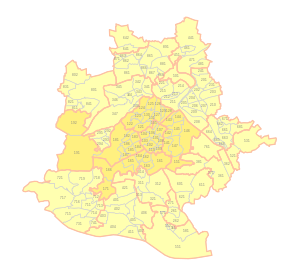
The city of Stuttgart is administratively divided into 23 city districts[169] – five "Inner" districts and 18 "Outer" districts. Each district has a Council headed by a District Director. From there, the districts are broken down into Quarters. Since the changes in city statutes 1 July 2007 and 1 January 2009, the total number of quarters rose to 152.[citation needed]

Recent election results

The 23 Municipalities and their Districts
Inner Districts
Stuttgart-Center (10), Stuttgart-North (11), Stuttgart-East (8), Stuttgart-South (7), Stuttgart-West (9)
Outer Districts
Bad Cannstatt (18), Birkach (3), Botnang (4), Degerloch (5), Feuerbach (8), Hedelfingen (4), Möhringen (9), Mühlhausen (5), Münster (1), Obertürkheim (2), Plieningen (5), Sillenbuch (3), Stammheim (2), Untertürkheim (8), Vaihingen (12), Wangen (1), Weilimdorf (6), Zuffenhausen (11)
Stuttgart-Center Stuttgart-North Stuttgart-East Stuttgart-South Stuttgart-West Bad Cannstatt Birkach Botnang Degerloch Feuerbach Hedelfingen Möhringen Mühlhausen Münster Obertürkheim Plieningen Sillenbuch Stammheim Untertürkheim Vaihingen Wangen Weilimdorf Zuffenhausen
Click me! Municipalities and Districts of Stuttgart
Party
Year
Regional
1999
European
1999
State
2001
Federal German parliament
2002
Regional
2004
European
2004
City Council
2009 (seats)
Federal German parliament
2005
European
2009
CDU 42.5% 42.9% 37.1% 35.1% 35.6% 37.4% 24.2% (15) 32.7% 29,1%
SPD 24.5% 27.6% 36.3% 35.7% 24.4% 21.2% 17.0% (10) 32.0% 18,0%
FDP 5.5% 6.2% 9.2% 8.5% 5.3% 7.7% 10.9% (7) 12.8% 14,5%
Green Party 14.1% 14.3% 11.5% 16.2% 17.2% 22.1% 25.3% (16) 15.0% 25,0%
Independent 5.6% – – – 8.5% – 10.3% (6) – 1,2%
Republicans 3.6% 3.6% 4.7% 1.0% 4.0% 3.3% 2.5% (1) 0.8% 2,0%
The Left – – – 1.4% 1.7% 1.9% 4.5% (2) 4.4% 4,5%
SÖS – – – – – – 4.6% (3) – –
Others 1.5% 5.4% 1.2% 2.1% 3.4% 6.5% 0.7% (0) 2.3% 6,7%
Election turnout[170] 59.1% 46.6% 65.5% 81.0% 54.0% 51.9% 48.7% 79.1% 52,3%

Demographics

The population of Stuttgart declined steadily between 1960 (637,539) and 2000 (586,978). Then low levels of unemployment and attractive secondary education opportunities led to renewed population growth, fuelled especially by young adults from the former East Germany.[160] For the first time in decades, in 2006 there were also more births in the city than deaths. In April 2008 there were 590,720 inhabitants in the city.[161]
Largest groups of foreign residents[162]
Nationality Population (2014)
 Turkey 19,124
 Greece 13,811
 Italy 13,647
 Croatia 12,919
 Romania 5,093
 Bosnia and Herzegovina 4,655
 Serbia 4,376
 Portugal 4,292
 Poland 3,226
 Kosovo 3,118

Immigrants

More than half of the population today is not of Swabian background, as many non-Swabian Germans have moved here due to the employment situation, which is far better than in most areas of Germany. Since the 1960s, many foreigners have also immigrated to Stuttgart to work here (as part of the "Gastarbeiter" program); another wave of immigrants came as refugees from the Wars in Yugoslavia in the 1990s. Thus, 40% of the city's population is of foreign background. In 2000, 22.8% of the population did not hold German citizenship, in 2006 this had reduced to 21.7%. The largest groups of foreign nationals were Turks (22,025), Greeks (14,341), Italians (13,978), Croats (12,985), Serbs (11,547) followed by immigrants from Romania, Bosnia and Herzegovina, Portugal, Poland, France, and Austria. 39% of foreign nationals come from the European Union (mostly Italy, Greece, and Poland).

Religion

The religious landscape in Stuttgart changed in 1534 as a direct result of the Reformation.[163] Since this time Württemberg has been predominantly Protestant. However, since 1975 the number of Protestants in Stuttgart has dropped from around 300,000 to 200,000. In 2000, 33.7% of inhabitants were Protestant and 27.4% were Roman Catholic. 39% of the population fell into other categories: Muslims, Jews and those who either followed no religion or one not accounted for in official statistics.

Unemployment

Unemployment in the Stuttgart Region is above the average of Baden-Württemberg, but very low compared to other metropolitan areas in Germany. In November 2008, before the annual winter rise, unemployment in the Stuttgart Region stood at 3.8%, 0.1% lower than the rate for Baden-Württemberg, in February 2009 it was 4.7%. Unemployment in the actual city of Stuttgart during the same periods stood at 5.2% and 6.0% (8 Nov and 9 Feb respectively). By comparison: unemployment for the whole of Germany stood at 7.1% (8 Nov) and 8.5% (9 Feb).[164][165]

Crime rates

Stuttgart ranks as one of the safest cities in Germany. In 2003, 8535 crimes were committed in Stuttgart for every 100,000 inhabitants (versus the average for all German cities of 12,751).[166] Figures for 2006 indicate that Stuttgart ranked second behind Munich.[167] 60% of Stuttgart crimes were solved in 2003, ranking second behind Nuremberg.