City government past and present
When Stuttgart was run as a (or within) the Duchy of Württemberg, it was governed by a type of protectorate called a Vogt appointed by the Duke. After 1811 this role was fulfilled by a City Director or 'Stadtdirektor'. After 1819 the community elected its own community mayor or 'Schultheiß'. Since 1930 the title of Oberbürgermeister (the nearest equivalent of which would be an executive form of Lord Mayor in English) has applied to Stuttgart and all other Württemberg towns of more than 20,000 inhabitants.At the end of the Second World War, French administrators appointed the independent politician Arnulf Klett as Burgomaster, a role he fulfilled without interruption until his death in 1974. Since this time Stuttgart has mainly been governed by the CDU. One former mayor was Manfred Rommel (son of perhaps the most famous German field marshal of World War II, Erwin Rommel).
As the capital of Baden-Württemberg, Stuttgart is an important political centre in Germany and the seat of the State Parliament, or Landtag as well as all Baden-Württemberg state departments.
In June 2009, for the first time the Greens gained the most seats in a German city with more than 500,000 inhabitants, effectively changing the balance of power in the city council. For the first time since 1972 the CDU no longer held the most seats, toppling its absolute majority shared with the Independent Party and the FDP. According to the German newspaper Die Welt, the main reason for the Greens' victory was disgruntlement with the controversial Stuttgart 21 rail project.[168]
Municipalities
The city of Stuttgart is administratively divided into 23 city districts[169] – five "Inner" districts and 18 "Outer" districts. Each district has a Council headed by a District Director. From there, the districts are broken down into Quarters. Since the changes in city statutes 1 July 2007 and 1 January 2009, the total number of quarters rose to 152.[citation needed]Recent election results
|
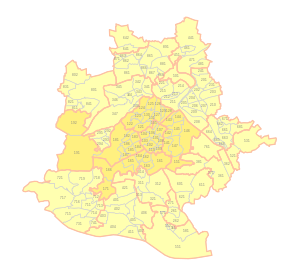 | ||||||||
Click me! Municipalities and Districts of Stuttgart
|
|||||||||
| Party Year |
Regional 1999 |
European 1999 |
State 2001 |
Federal German parliament 2002 |
Regional 2004 |
European 2004 |
City Council 2009 (seats) |
Federal German parliament 2005 |
European 2009 |
|---|---|---|---|---|---|---|---|---|---|
| CDU | 42.5% | 42.9% | 37.1% | 35.1% | 35.6% | 37.4% | 24.2% (15) | 32.7% | 29,1% |
| SPD | 24.5% | 27.6% | 36.3% | 35.7% | 24.4% | 21.2% | 17.0% (10) | 32.0% | 18,0% |
| FDP | 5.5% | 6.2% | 9.2% | 8.5% | 5.3% | 7.7% | 10.9% (7) | 12.8% | 14,5% |
| Green Party | 14.1% | 14.3% | 11.5% | 16.2% | 17.2% | 22.1% | 25.3% (16) | 15.0% | 25,0% |
| Independent | 5.6% | – | – | – | 8.5% | – | 10.3% (6) | – | 1,2% |
| Republicans | 3.6% | 3.6% | 4.7% | 1.0% | 4.0% | 3.3% | 2.5% (1) | 0.8% | 2,0% |
| The Left | – | – | – | 1.4% | 1.7% | 1.9% | 4.5% (2) | 4.4% | 4,5% |
| SÖS | – | – | – | – | – | – | 4.6% (3) | – | – |
| Others | 1.5% | 5.4% | 1.2% | 2.1% | 3.4% | 6.5% | 0.7% (0) | 2.3% | 6,7% |
| Election turnout[170] | 59.1% | 46.6% | 65.5% | 81.0% | 54.0% | 51.9% | 48.7% | 79.1% | 52,3% |

No comments:
Post a Comment